
Why India Lags in Global Nutraceuticals
India has the heritage, the raw materials, the Ayurveda tradition and the manufacturing scale to become a global force in preventive healthcare. We are well placed to emerge as the true “Pharmacy of the World” not just for medicines, but for wellness, prevention and long-term health. Yet when we look at the global stage, there is still a clear gap between our potential and our actual market share.
What the numbers say
The global nutraceutical market is estimated to reach around USD 683 billion in 2026, while the Indian nutraceutical market stands at USD 42.7 billion, accounting for less than 7% of the global market share.
At the same time, India’s broader preventive healthcare market, including wellness, dietary supplements, fitness, and diagnostics, is valued at approximately USD 170 billion, growing at a CAGR of over 20%.
This contrast is telling. Domestic demand and manufacturing capability are accelerating rapidly, but India’s global positioning in preventive healthcare and wellness exports is still evolving.
What my poll revealed
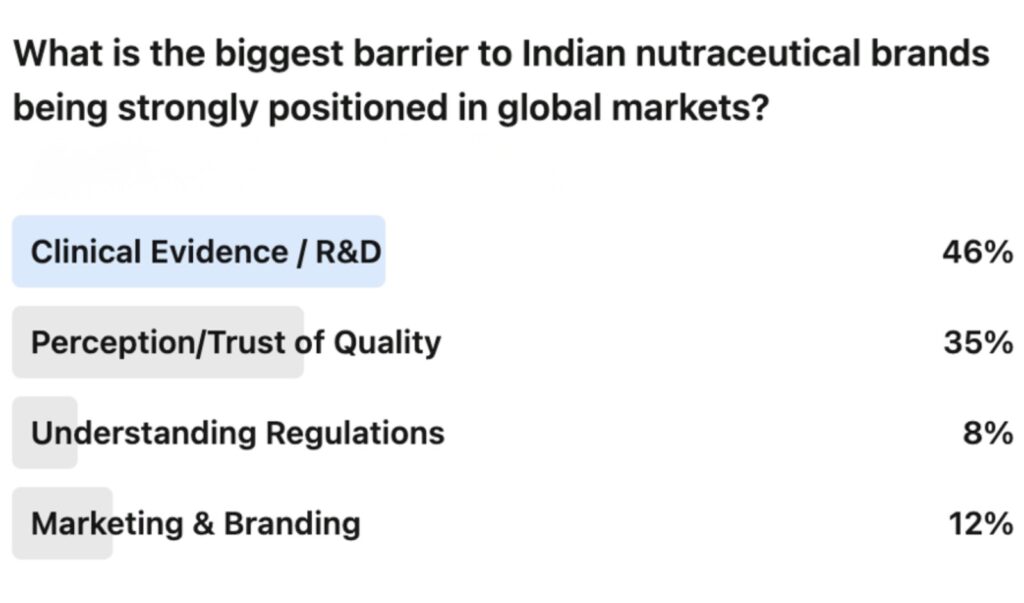
These responses are telling. They suggest that India’s challenge is not manufacturing capacity or cost competitiveness, we already excel there in pharmaceuticals but in building ingredients or products that are backed by robust science that can win global trust. The need is to create compelling nutraceutical brands.
Moving from promise to leadership
The message is simple. India does not lack products. It lacks enough proof-backed visibility. That is where the next phase of growth must begin. The country needs to move from being seen largely as a manufacturing hub to being recognised as a scientifically validated preventive healthcare leader. For that, policy support will matter, but industry action will matter just as
much.
The government can play a major role by formally recognising nutraceuticals as a subject within medicines, pharmacy and healthcare education, so that the ecosystem develops a deeper understanding of preventive care, evidence generation and product credibility. This is not just an academic change. It is a strategic one. If India wants to lead the world in preventive healthcare, the sector must be understood with the same seriousness as other branches of medicine and health science.
At the same time, India needs a much larger and more accessible network of lab infrastructure for testing and clinical trials. Without that, even the best products will struggle to generate the kind of evidence global markets now demand. Testing should not remain concentrated in a few centres or remain too expensive for smaller innovators. A stronger, wider and more efficient testing ecosystem will help the industry scale faster and with greater credibility.
At the same time, India needs a much larger and more accessible network of lab infrastructure for testing and clinical trials. Without that, even the best products will struggle to generate the kind of evidence global markets now demand. Testing should not remain concentrated in a few centres or be too expensive for smaller innovators. A stronger, wider, and more efficient testing ecosystem will help the industry scale faster and with greater credibility.
Encouragingly, policy intent is beginning to align with this need, as reflected in the announcements made in the Union Budget 2026–27. The proposed BioPharma Shakti initiative, backed by an outlay of ₹10,000 crore, signals a clear push towards strengthening capabilities in biologics, biosimilars, and vaccines. This is further reinforced by efforts to expand the clinical research footprint through a network of over 1,000 accredited trial sites under ICMR, which can help democratise access to trials and bring greater diversity into patient participation. At the same time, the expansion of institutional capacity through new NIPERs, along with the upgradation of existing ones, is expected to deepen the talent pool and enhance research quality.
Taken together, these developments indicate a gradual but important shift towards building a more distributed, credible, and globally aligned testing ecosystem in India.
But this cannot be left only to the government. Industry players must step up too. Why wait for public infrastructure alone when companies can co-invest in building it? Brands, manufacturers and ingredient companies should jointly support R&D, testing facilities, clinical trial partnerships and evidence generation platforms. A stronger industry-led push would not only speed up innovation, it would also reduce dependence on policy timelines.
Transparency must also become part of the product itself. Every nutraceutical label should ideally carry a QR code that allows consumers to access clinical trial results, quality certifications and product-specific evidence in a simple, readable format. In an age where consumers research everything before buying, this kind of direct proof can become a major trust signal. It turns a claim into a verifiable fact.
Another important opportunity lies in trade policy. India has signed several FTAs, while we are also in the process of signing more, and are in the execution phase of some existing agreements. This is precisely the right moment to ask the government to actively promote preventive healthcare and nutraceuticals within FTAs, the way it supports textiles and other strategic sectors. India has a long and respected history of herbs and Ayurveda, and that story should be carried forward in trade negotiations as part of the country’s broader wellness export identity.
If India wants its preventive healthcare sector to win globally, it will need three things working together: stronger evidence, better infrastructure, and robust policy advocacy. The opportunity exists. The foundation is built. Now the ecosystem must come together to convert heritage and scale into global leadership. emit blue light that seems to severely damage our eyeballs over time. Much of this can be partly prevented through regular use and application of nature’s concoctions to save our optics and reverse some of what has been lost.